The Daily Mirror has reported that as of yesterday, the canteen in the Parliament will now offer pork. This is a question that came up a long time ago, but why did the Speaker, in the midst of all this controversy, decide to throw more fat on the fire?
Even if there were perfectly good reasons to change the status quo, it is incredibly stupid to have done so now. Unless of course the timing was deliberate, calculated to send a message to the Muslims. Actions speak louder than words and this only serves to support the contention that the on-going campaign has their support.
The Government is very good at words and has succeeded fooling a surprisingly large number of people for a long time. Sooner or later people will have to learn that they need to watch its actions, rather than be seduced by its words.
We seem to be sliding dangerously fast down a very long spiral, wonder where it will end, and who will be next?
Friday, February 22, 2013

Another hotel raided - for having pictures and statues of the Buddha ?
This was something that I heard on a Sinhala news station (FM 100.0) on the way to work. I can't seem to find references in English online.
Apparently the incident took place yesterday, after the Sinhala Ravaya received information that a hotel in Induruwa had pictures and statues of the Buddha displayed in an 'inappropriate' manner. The Sinhala Ravaya visited the hotel and apparently agreed that the the way the images were displayed 'would cause pain of mind to buddhists',- my rough translation of what the spokesman said.
Some altercation or argument had followed with the German owners of the hotel and the police had been informed.
Related posts, here and here.
Thursday, February 21, 2013
New Urban Price Index shows 20% inflation
A local investment bank, Capital Alliance, (CAL) has developed a new measure of urban inflation that puts inflation at 20.6% in the year 2012.
When looking at inflation, it is important to note that he impact of increases in prices is something that is unique to each individual; dependent on the spending pattern of each individual.
To take a simple example a person who smokes will be affected by increases in tobacco prices but someone who does not is remains unaffected. Increases in fuel prices will have a greater impact on people who have to commute long distances, increases in school fees only affect households with school going children and so forth.
Nevertheless, it is necessary to measure inflation in some way because it affects the well-being or standard of living of people.
In simple terms, a person's standard of living is dependent on two things; their level of income and the buying power of the money that they earn. If prices remain absolutely static, each increase in wages will translate to an increase in disposable income. However if prices rise faster than wages, disposable income will fall. Therefore it is not just wage increases that matter but their relative increase in relation to prices.
It is worth remembering that while wages will rise once; or if one is lucky, twice a year. Prices can rise every day, hence the importance of battling inflation. In order to slay the beast, one must at know it, therefore the need for some way of measuring how prices increases affect the average citizen.
In order to be realistic, an inflation index must be based on the average expenditure of a typical household. Defining this is fraught with difficulties but as there has been enough debate on the subject, statisticians have developed standard methodologies that are broadly acceptable.
A government that wishes to hoodwink its people can do so by changing the methodology. Many analysts have already accused the Government of manipulating the index, so an independent index is welcome. CAL says their index applies to about half of all city dwellers. Excerpts from the report:
CAL produces some interesting research and I think they are a pretty decent outfit, check their website. Some of their research is published, although the report on inflation is not. I'm sure they will give you a copy if you call on their office.
Their index may not be perfect but it is definitely a better reflection of the impact of inflation on urban households. I certainly feel the pinch myself, money just seems to evaporate, especially over the past few months. Any comments from readers will be welcome.
When looking at inflation, it is important to note that he impact of increases in prices is something that is unique to each individual; dependent on the spending pattern of each individual.
To take a simple example a person who smokes will be affected by increases in tobacco prices but someone who does not is remains unaffected. Increases in fuel prices will have a greater impact on people who have to commute long distances, increases in school fees only affect households with school going children and so forth.
Nevertheless, it is necessary to measure inflation in some way because it affects the well-being or standard of living of people.
In simple terms, a person's standard of living is dependent on two things; their level of income and the buying power of the money that they earn. If prices remain absolutely static, each increase in wages will translate to an increase in disposable income. However if prices rise faster than wages, disposable income will fall. Therefore it is not just wage increases that matter but their relative increase in relation to prices.
It is worth remembering that while wages will rise once; or if one is lucky, twice a year. Prices can rise every day, hence the importance of battling inflation. In order to slay the beast, one must at know it, therefore the need for some way of measuring how prices increases affect the average citizen.
In order to be realistic, an inflation index must be based on the average expenditure of a typical household. Defining this is fraught with difficulties but as there has been enough debate on the subject, statisticians have developed standard methodologies that are broadly acceptable.
A government that wishes to hoodwink its people can do so by changing the methodology. Many analysts have already accused the Government of manipulating the index, so an independent index is welcome. CAL says their index applies to about half of all city dwellers. Excerpts from the report:
CAL developed the Urban Price Index (UPI) to measure the inflation middle class households in cities endure with a greater degree of accuracy than the gov’t’s CCPI. The CAL UPI uses the Laspeyres* method to calculate changes in prices with 2012 as the base year. CAL assumes a monthly income of LKR 80k/household of four with 56% of the income spent on goods in the basket (Jan 2012). The basket includes food and beverages, communication, transportation and energy costs. The CAL UPI shows a 20.6% YoY increase in the costs of living for an urban household while the CCPI depicts only a 9.8% increase. The CAL UPI applies to over half of all city dwellers.
Assumptions
Income Level
We have assumed a LKR 80k average middle class household income per month, taking two working members in a family of four. This is based on the “Household Income and Expenditure Survey - 2009/10”. CAL has adjusted the 2010 average urban household income of LKR 60k (which represent +54% of Sri Lankan urban households in 2010) to LKR 80k (based on per capita income growth).
CAL UPI Basket
The items in the CAL UPI basket are samples that represent a wider range of goods and services purchased by urban middle class households. There are 30 individual goods and services in the basket. Certain items have been taken as proxies for others not included, but exhibit similar price changes. For example, Chili powder is in the basket, but turmeric and pepper are not. Expenditure on pepper (and other spices not in the basket) is allocated to chili powder proportionate to spending.
CAL UPI is based on the Laspeyres method – CAL’s UPI basket will not change over time and therefore should provide a more accurate depiction of price changes.
The following items have not been considered in the CAL UPI basket.
Health - Primary level universal health care is provided free of charge in Sri Lanka. Further, a majority of the middle class population is covered by insurance schemes paid by the employers.
Education - Sri Lanka has a free, compulsory education system for primary and secondary students up to the age of 18.
Accommodation – For a more objective analysis, we have not included rents.
CAL produces some interesting research and I think they are a pretty decent outfit, check their website. Some of their research is published, although the report on inflation is not. I'm sure they will give you a copy if you call on their office.
Their index may not be perfect but it is definitely a better reflection of the impact of inflation on urban households. I certainly feel the pinch myself, money just seems to evaporate, especially over the past few months. Any comments from readers will be welcome.
Tuesday, February 19, 2013
Good Sri Lankan food: essential factors
An old travel guide once said that Sri Lankan food, while not ranking amongst the great cuisines of the world, was tasty, if a little hot; sentiments that I broadly agree with.
Now, pampered soul that I am (ie typical Sri Lankan male), cannot cook; but I do fancy myself as an armchair critic. My critical mind was thus deeply concerned when I thought I detected a deterioration in my mother's cooking.
I was trying to figure out why and I noticed that the deterioration coincided with the arrival of some new Pyrex cooking pots; ones that could be taken off the fire and put straight on the table. Once finished with, they could be put into the fridge with no further ado. An enormous saving in labour compared to the traditional clay "chatty" pot. Unfortunately the convenience comes at a cost; somehow the clay pot enhances the flavour of the cooking, something the Pyrex cannot do.
The second revelation came when I visited a friend's estate and the servants cooked us a simple meal in the traditional way. The first mouthful made me realise that there was a distinct smoky taste to the food; something that enhanced the experience immensely. The smoky taste is imparted by the wood fire, used for cooking. I believe this is also a factor, apart from appealing to our primaeval subconscious; open fire under starlit skies; of a good barbeque.
Therefore, the secret to really good local food is to have it cooked in a clay pot, on a wood fire. I ventured to make these helpful suggestions for improvement to my mother but was sent packing, in short order.
After a further visit to my friend's estate and examining the stove in the blackened walls of the kitchen, I realised the difficulty with wood fires. Lighting them is problematic and, once lit, controlling the flame to ensure steady cooking is also quite tricky, thus not possible unless one has good staff to help. The soot in the kitchen and the messiness of washing the clay pot (it does not scrub easily and needs to be soaked) means that it is no longer viable for small households in the city.
Nevertheless, I think this is the type of food that should be attempted when on holiday. Estate bungalows are generally equipped for this type of cooking although many have switched to gas for convenience but it is worthwhile, when making arrangements to see if the 'appu' can be persuaded to cook a few things the old-fashioned way. Perhaps this is something that smaller hotels could also consider offering clients, to distinguish themselves from the mass. Simple traditional food, cooked in the traditional way, with fresh local ingredients should be a good selling point.
The many domestic goddesses who used to inhabit the blogosphere will no doubt relish the opportunity to break out grandma's cooking implements, so let me know the results, or better still, invite me over to taste the food? I'm sure my advice warrants it.
Friday, February 15, 2013
Who should regulate Halaal products?
Since this has become a subject of heated discussion at home, it is worth reading this a more distant view, from The Economist.
Thursday, February 14, 2013
Tourist arrested for having a tattoo of a Buddha?
This is what was reported on this site. Other news sites carry similar stories.
The question is, under what law was she charged? Presumably something twisted to fit the purpose. It was only a few months ago that tourists were arrested for taking photographs of statues.
More worrying is that this seems to demonstrate a new level of hyper-religiosity, which in the context of the on-going anti-muslim campaign seems to suggest that an explosion is around the corner. Is anybody still even talking of a 'peace dividend'?
We should also carry a warning to tourists, perhaps it should read: Beware! The natives are not friendly.
Tuesday, February 12, 2013
Sexism and gender based violence in Sri Lanka
An old family friend of my Uncle, when explaining something to a girl from Britain remarked that "in the East, it's a man's world". This elderly gentleman would never have dreamed of being discourteous to a woman, let alone ill-treating one, but it typifies the latent sexism in our society.
Gender based violence in Sri Lankan cinema was the subject of a discussion this evening, held in connection with the One Billion Rising campaign to stop violence against women. I confess that the actual presentation went over my head but the discussion afterwards proved to be fruitful.
There is some awareness the harassment that women face on a daily basis but few are aware of some of the types of abuse that take place at home and work. I refer to a common practice whereby a boy's first sexual experience would take place with a servant of the house.
I first encountered this practice as a 17 year old in the A level class, where one of my classmates was describing an 'encounter' with his servant and was happily inviting a few of his friends over to do the same. I, having sneaked through my father's collection of Penthouse magazines and, in passing, read an article about "When No means, No", knew this was rape, but not knowing how to confront them, kept silent. Later I found this practice to be rampant, most would say at least half the boys in a certain sort of school went through this.
For some it was a just a passing phase. For others it was a habit that they would return to in later years, often when drunk. This I learned from a female friend who had to rescue her servant from her brother-in-law, who would habitually return to the practice of his school days when drunk. My friend had to threaten to rat on her B-I-L to her M-I-L to get him out of the servant's bed. The experience sickened her and eventually contributed to the ending of her marriage (to another sexist), but that is another story.
This behaviour is impossible to justify, but it may owe its origin to an earlier, feudal practice where the landlord or 'Hamu' would take a woman from the estate to be his concubine.
With many more women entering the workforce there is also an increase in the abuse of power by male managers. A friend of mine who used to work for a large multinational was narrating a tale of how the managers would wait, almost drooling at the thought, for the next batch of interns to come in. They would pounce and groom them for sex. I asked if the company had no code of ethics. He said as long as it was voluntary, and indeed it was, nobody could say anything. What may have been missed however was that this was an abuse of a power relationship, which should have been covered in the manual of ethics. My friend and I were cursing our poor upbringing which prevented us from doing the same.
A similar problem exists in the tutories with some teachers abusing the pupil-teacher relationship for sexual gain. Again, things are entirely voluntary but the pupil-teacher relationship, just like the boss-subordinate relationship, is a relationship of power. Women are attracted by power and it is the abuse of this power that presents the ethical dilemma.
Perhaps these are minor quibbles, compared to the bigger abuses going on, but something to reflect on nevertheless.
One of the other points that was raised in the discussion was economic abuse, but this was quickly dismissed since around 40% of the workforce was estimated to comprise women. A subtle factor may have been missed however, the number of women working as teachers.
I have come across at least a couple of instances where women have been steered out of careers in the corporate world to become Montessori teachers. This is done by their husbands ostensibly to give them a better work-life balance, but as one husband confessed to me, in order to ensure that they do not start affairs with male colleagues.
The Montessori schools tend to be run entirely by women so insecure males feel safe in shunting their wives into this, away from the preying eyes of other males. Again there is no compunction or coercion used, just gentle persuasion, so not a major problem in itself, just that it is a more acceptable manifestation of an old prejudice.
I of course, being a man of enlightenment betray no such prejudice, although I may admit to being pampered a bit. Just a bit.
I don't cook, I don't wash clothes, I can't iron; all these mundane things are taken care of. I don't really know how, food appears, dirty clothes disappear and appear, washed and ironed, as if by magic. I spend my time at the gym, at concerts, reading or conversing friends and improving my mind. I fully subscribe to the concept of sharing work and say I would gladly share daily chores with a potential wife, even though I've never lifted a finger at home.
I'm pretty sure I am a model citizen, many would agree. Am I, really? Perhaps we all need to turn the searchlight inwards and to ask ourselves a few hard questions?
Sunday, February 10, 2013
One Billion Rising: A campaign to stop violence against women
One Billion Rising Sri Lanka (link to FB page) is the local chapter of a worldwide campaign to stop violence against women.
OBR Sri Lanka will be organising a demonstration at Lipton Circus at 4.30pm on Thursday, 14th of February 2013 followed by a candlelight vigil at the same location at 6pm, dedicated to all the women and children who have been abused, harassed, raped and killed because of Gender Based Violence. They invite everyone to come dressed in black, red or pink to show your solidarity towards the movement.
Its a good cause, I think one should support it in whatever way one can, not least by speaking up whenever we witness it, in our houses, families or amongst friends.
Thursday, February 07, 2013
Land sales to Chinese and land taxes: rewriting Economics
Last year the Government imposed new taxes on the sale or lease of land to foreigners. The tax on the sale of land has been around for a while but what was new was the extension of the tax to cover leases and companies owned by foreigners.
Companies incorporated in Sri Lanka are, in every other aspect, treated as resident. However in the case of land, local companies will be treated as non-resident, if a foreigner owns more than 25% of the equity.
Ostensibly, the policy seems to be aimed at discouraging foreigners from owning or leasing land. Yet property development by foreigners seems to be a central plank in Government economic policy.
Can these two apparently contradictory stands be reconciled?
The only way in which these can be reconciled is if the Government is prepared to waive the taxes for chosen developers, which has transpired in the purchase of some prime land by the Chinese. In other words, citizens will encounter great difficulty in selling land to foreigners but not the Government.
In effect, the Government is securing for itself a monopoly on land sales and, as with all monopolies, enables it to earn what are termed "super profits". Thus if a citizen owns a piece of land that a foreigner wants to buy, the cheapest way sell it would be for the Government to buy the land and then sell it to the foreigner, after waiving the tax. This means that profits that should legitimately go to the citizen are being appropriated by the state.
The Chinese deal however looks even stranger because apart from the tax being waived, the property is also being sold below the value specified by the Chief Valuer. Instead of a super profit being earned we have the the opposite: less than normal profit being earned. How can this be?
The normal laws of economics do not seem to apply or, if they are to apply, will do so only if the assumption is made that the super profit was indeed earned, but did not accrue to the state.
This assumption however is clearly absurd, therefore we may conclude that the laws of economics need to be rewritten. A good subject for your PhD, Mr Cabraal?
Sunday, February 03, 2013
Sri Lanka's Muslims under threat
Sri Lanka's Muslim's have become the target of an organised campaign of hate. How should the Government and ordinary citizens react to this?
The reaction of the UK government to a controversy surrounding traces of pork DNA being found in halal products is instructive. Following the discovery of horse meat in beef burgers, testing was done on a variety of meat products, wherein traces of pork DNA were found in halal food served in prisons.
The reaction from the UK government was swift: the supplier was suspended and investigations launched simultaneously by the Prison Service and the local authority. The Food Standards Agency, which is responsible for food safety and food hygiene across the UK, called an urgent meeting of major retailers and suppliers on Monday, to ensure that everyone is fully aware of their responsibilities.
Back in the Paradise Isle, the President instructs the Secretary to the Ministry of information and Mass Media "to take immediate action against those electronic and print medias, which spew venom against the Muslims."
What? Is the media the problem? It is the organisations behind the campaign, the very organisations that met the President that need to be brought to heel, not the media.
The President asked the organisations not to engage in activities seen to be promoting communal hatred and said that people should be mindful of attempts to tarnish the image of the country.
Mindful of attempts to tarnish the image of the country? Really? A more wishy-washy, watered down statement could not be imagined, worthy of Ranil Wickremasinghe, who for his part has remained deafeningly silent on the matter. No condemnation, apology or even a firm statement and nothing, beyond a vague promise to appoint a Parliamentary Select Committee (which a long-drawn out, time consuming thing), of any action.
What a contrast to that of the UK Government which regards its Muslim community which has existed only for around fifty years as equal citizens.
To come back to my question, what should citizens do? There does not seem to be much, but on the eve of independence day, perhaps we should make it a point to go out of our way to patronise Muslim owned shops.
I've never shopped at No Limit, I never even realised it was Muslim-owned, I don't really need to shop for clothes either but I will drop in and buy something. Even if its only a pair of socks, a point needs to be made.
The reaction of the UK government to a controversy surrounding traces of pork DNA being found in halal products is instructive. Following the discovery of horse meat in beef burgers, testing was done on a variety of meat products, wherein traces of pork DNA were found in halal food served in prisons.
The reaction from the UK government was swift: the supplier was suspended and investigations launched simultaneously by the Prison Service and the local authority. The Food Standards Agency, which is responsible for food safety and food hygiene across the UK, called an urgent meeting of major retailers and suppliers on Monday, to ensure that everyone is fully aware of their responsibilities.
"It is the responsibility of food businesses to ensure the food they sell contains what it says on the label. We are considering, with relevant local authorities, whether legal action is appropriate following the investigation."
The Prison Reform Trust said it welcomed the immediate apology and investigation. Its director Juliet Lyon said: "This is not a matter of dietary preference but of Islamic law.
"There are clear hospital and prison rules that halal meat must be on the menu."
"This lapse will have offended and distressed high numbers of Muslim prisoners and their families so apologising, suspending the supplier and investigating the incident are the right steps for the Ministry of Justice to take." (from The Guardian)
Back in the Paradise Isle, the President instructs the Secretary to the Ministry of information and Mass Media "to take immediate action against those electronic and print medias, which spew venom against the Muslims."
What? Is the media the problem? It is the organisations behind the campaign, the very organisations that met the President that need to be brought to heel, not the media.
The President asked the organisations not to engage in activities seen to be promoting communal hatred and said that people should be mindful of attempts to tarnish the image of the country.
Mindful of attempts to tarnish the image of the country? Really? A more wishy-washy, watered down statement could not be imagined, worthy of Ranil Wickremasinghe, who for his part has remained deafeningly silent on the matter. No condemnation, apology or even a firm statement and nothing, beyond a vague promise to appoint a Parliamentary Select Committee (which a long-drawn out, time consuming thing), of any action.
What a contrast to that of the UK Government which regards its Muslim community which has existed only for around fifty years as equal citizens.
To come back to my question, what should citizens do? There does not seem to be much, but on the eve of independence day, perhaps we should make it a point to go out of our way to patronise Muslim owned shops.
I've never shopped at No Limit, I never even realised it was Muslim-owned, I don't really need to shop for clothes either but I will drop in and buy something. Even if its only a pair of socks, a point needs to be made.
Thursday, January 31, 2013
Dayan Jayatilleka on democratic resistence
Dayan Jayatilleke has articulated a manifesto for what he calls democratic resistance.While Mr Jayatilleka's learning and erudition are beyond doubt, he seems naive when he hopes that "almost nothing done can be reversed when elections come around".
The error lies in assuming that the holding of elections could result in a change in regime. This has happened only once in the last 32 years - in 1994 when Chandrika Kumaratunga succeeded in toppling the UNP regime, which, as we were ceaselessly reminded, ruled for 17 years. We were only spared the propaganda once the present regime clocked up its 17th year. They are about to embark on their 19th year and show no sign of slowing down.
Under previous constitutions, incumbent regimes changed in 1956, 1960, 1965, 1970 and 1977. In the thirty years since 1948 five changes in incumbency took place.
Since the constitution of 1978 there has only been a lone instance of an incumbent losing: in 1994. Given that the 'born loser' Ranil Wickremasinghe lead the opposition at the time, perhaps the loss is not so surprising.
It is also worth noting that each and every incumbent, bar one, succeeded in serving the full term permitted under the constitution, until handing over to his chosen successor within the party. The only one who failed to serve the full two terms permitted by the constitution was Premadasa, who was assassinated.
The reason for the lack of change is in the constitution: the incumbent is all-powerful, has control of all the resources of the state that can be wielded against his opponents. The recent amendments to the constitution have increased the power of the Executive enormously; most notably by abolishing term limits and independent commissions. Further amendments to curb the little independence enjoyed by the judiciary should seal the power of the Executive permanently.
The essence of a functioning democracy are the institutional curbs placed, by constitution or tradition, on the power of the Executive. Traditionally the institutional curbs comprise:
a) an independent civil service (which runs day to day administration, serving citizens equally irrespective of political affiliation);
b) an independent judiciary;
c) the separation of powers between the legislature and executive and the accountability of the executive to parliament;
d) a free press which exposes the faults of Government.
In the current set up where members cross over for cash reward, parliament is little better than a rubber stamp. The civil service was disbanded in 1965 and its last vestiges of independence probably disappeared in the 1980's. Of the press, enough has been said, most that are left standing have learned that it is best to tow the line and the judiciary, already greatly compromised, have now been brought to heel.
As there are no institutional checks left, the rulers enjoy unprecedented power to distribute largesse to voters at elections, intimidate or cripple opponents, disenfranchise minorities, stuff ballots and otherwise 'manage' the electoral process to deliver expected results.We have witnessed many instances of this in the past, only the degree of the tactics need to be increased to compensate for the inevitable decline in popularity.
Eventually the tactics will need to be so blatant that only the blind will refuse to see, but elections will continue to be held, regularly. Even Robert Mugabe managed to to be returned to office, with come conviction, over a good thirty years.
Of the four points Mr Jayatilleke highlights only the fourth: that the most significant political enterprises in the politics of this island have taken the form of ruptures with pre-existing organisations; has any validity. In this case, as other actors and organisations have no power and do not matter, the rupture will take the form of a family squabble.
This is the other important point of note: previously the baton of power was handed down within the party; as in the case of communist China; now it will be handed down within the family, in the traditional feudal fashion.
His other points have some meaning only in the context of a reasonably free election. For the reasons pointed out above, elections are heavily weighted in favour of the incumbent and are thus hardly fair, even if they may be reasonably free, which may not necessarily be the case.
Wednesday, January 30, 2013
A never ending nightmare: will 2015 witness a recurrence of 1915?
"If history repeats itself, and the unexpected always happens, how incapable must Man be of learning from experience." George Bernard Shaw
While a report from a commission to learn lessons lies mouldering in the grave, the promise of the appointment of yet another parliamentary select committee to investigate the problem gives little hope. They will produce yet another report that will be buried, assuming that they even get as far as producing a report, while the storm clouds continue to gather.
"The Buddhist-Muslim riots of 1915 are often depicted as an eruption of religious animosity and friction between Sinhalese Buddhists and a section of the Muslim population. According to this viewpoint, the riots were sparked by religious fanaticism as the Buddhists saw in the ‘intolerance and aggressiveness of the Muslims, a permanent danger to their religious practices and celebration of their national festivals.’ This interpretation of the riots, however, disregards several signficant economic and political developments which influenced the events of 1915 and leaves unanswered the important question of why, if the riots were merely a reflection of religious tensions, the British colonial officials took such drastic measures during the riots and exacted severe reprisals long after the rioting was over.
The quote from Kumari Jayewardena is eerily reminiscent of sentiments being expressed today. DBS Jeyaraj's article on an incident in Kuliyapitiya one of a series that have taken place of late; sets a pattern that should alert the authorities to trouble brewing.In the years before the riots, an awakening had taken place among the Sinhalese Buddhists which was not only a reaction to British political domination, but also an act of self-assetion against the economic power of minority groups in Ceylon. The rioteers of 1915 have often been portrayed as criminals and hooligans out for plunder; but there is evidence that in Colombo it was not the criminal and rootless elements who led the riots, but the skilled, better-paid, more militant segments of the working class. The government was aware of this potentially explosive facet of the Colombo rioting, which turned into an expression of revolt against economic exploitation. Furthermore, many British officials in Ceylon, alarmed by the spread of nationalism and industrial unrest in both India and Ceylon and perhaps apprehensive about the prospects of German intrigue in Asia during the First World War, were convinced that the rioting was directed against British rule…" Kumari Jayewardena (1970). Extracted from here.
While a report from a commission to learn lessons lies mouldering in the grave, the promise of the appointment of yet another parliamentary select committee to investigate the problem gives little hope. They will produce yet another report that will be buried, assuming that they even get as far as producing a report, while the storm clouds continue to gather.
Sunday, January 27, 2013
Kotagala - Nuwara Eliya Road (A7) in a bad state
Just a travel update, the Kotagala - Nuwara Eliya road (the main A7 road, see map) is under repair and in a very poor state. The heavy rain and recent landslides seem to have washed away most of the surface of the road leaving it a mass of pot holes.
The road is not impassable for cars but it is very bumpy and can take a severe toll on the suspension. Would advise anyone contemplating travel on this road to do so in a high clearance vehicle (van or 4WD). There is an alternate route, through the Fordyce Estate (see map) , a longer route on estate roads (which are not great either) and difficult to navigate (as I am told it is not well sign posted) so get clear directions from someone familiar with the area or have the route premarked on Google maps. On the plus side, this route is supposed to be the prettier of the two.
The repairs seem to be part of a huge exercise in road widening so are likely to take some time to complete.
One of the mysteries on the road were short stretches (of 2-3km) that had been repaired which were sandwiched between long tracts of rutty road. The worrying thing was that on several of the rutty stretches there were no building materials or people in sight, although there was some visible activity on others.
Wednesday, January 23, 2013
Democracy works
DD has posted something that concludes with the above line. I tend to think it does as well, but why?
Most probably because in Britain (and in the 'West') it has evolved and been refined over time. The freedoms of the citizenry of England were hard fought and won over the course of many centuries. The freedom that they enjoy is freedom from the King, once all powerful, now reduced to a mere figurehead, sometimes an object of ridicule. The concept is now in their bones and the king dare not reassert his authority.
When Britain abandoned its empire in haste, democracy, the only form of governance they knew, was transplanted. In the wilting heat of the tropics the flower only took root in a handful of places. It flowered wherever the gardeners left the plant in its pot and did not prune it too harshly, until it became a part of the natural way of life, its processes beyond question.
In places where, post-independence it was tinkered with, it withered.
The various kings who evolved over eons to lead the many tribes of mankind did so because they offered their tribesmen protection from external enemies and as an arbiter of internal disputes. Later minimal public services were offered. The king was the most powerful, he came to run the militia, so he made the rules. Naturally there were costs associated with this, so the king extracted money from the tribe to pay for these costs-this was taxation.
The problem was that eventually the King tended to start misusing the proceeds of taxes for his own benefit and otherwise abusing power. As the King had the army with him, doing anything about an exploitative ruler was a difficult struggle.
The fruit of that struggle was democracy. In Sri Lanka with two new constitutions and almost a score of amendments to the last one; the tree has been dug up at the very roots. A feudal kingdom is in the ascendent. "We shall reclaim our glorious history", cry the courtiers. The population, blinded by their hatred of the decadent West, applaud.
Our rulers claim to offer protection; from enemies without and terrorists within, just as the kings of old did. Sure, they will save us from our enemies but who will save us from them?
LBO has an excellent article on a related aspect.
Saturday, January 12, 2013
Anniversaries, 2003, 1933 and 2013
Anniversaries are strange things, the only ones worth remembering as children are birthdays and Christmas. As adults, they matter less and are mostly a preoccupation of the old.
The old have little to look forward to and as the sands of time pass, school reunions and obituary notices take on an importance that is little understood by the young.
Looking back is not only an exercise in nostalgia, it also an opportunity to reflect on events past. Distance brings detachment and perspective.
I just realised that it was ten years ago this year that the UNF government was sacked (that took place on the 4th of November), but in January 2003 we were not to know how fast we were approaching the cliff face. Those were heady days of boundless optimism and seen from the perspective of today, from an altogether different era, closer to 1953 than 2013.
This month, another anniversary has crept up, nearly unnoticed. It was in the January of 1933 that Hitler became chancellor of Germany, and by August 1934, he had declared himself Führer - the leader of Germany. In a few short months he dismembered Germany's democracy.
A mysterious fire in the Reichstag in January 1933, provided the excuse to crack down on the communists who were said to be behind the attack. Hitler urged President Paul von Hindenburg to pass an emergency decree to counter the "ruthless confrontation of the Communist Party of Germany". (Wikipedia)
The Reichstag Fire Decree was used as the legal basis of imprisonment of anyone considered to be opponents of the Nazis, and to suppress publications not considered “friendly” to the Nazi cause. The government instituted mass arrests of Communists, including all of the Communist parliamentary delegates. With them gone and their seats empty, the Nazis went from being a plurality party to the majority (Wikipedia).
In March 1933, the Nazi's passed the Enabling act. The formal name of the Enabling Act was Gesetz zur Behebung der Not von Volk und Reich (English: "Law to Remedy the Distress of People and Reich"). (Wikipedia)
An innocuous act for the uplifting of lives. Now why does that ring a bell?
It was passed with the assistance of the SA (Sturm Abteilung also known as stormtroopers or brownshirts) who intimidated the opposition.
Before the vote, Hitler made a speech in which he pledged to use restraint.
"The government will make use of these powers only insofar as they are essential for carrying out vitally necessary measures...The number of cases in which an internal necessity exists for having recourse to such a law is in itself a limited one," Hitler told the Reichstag. (Link to source)
Under the Act, the government had acquired the authority to pass laws without either parliamentary consent or control. Unprecedentedly, these laws could (with certain exceptions) even deviate from the Constitution. The Act effectively eliminated the Reichstag as active players in German politics, though the existence of the body, alongside that of the Reichsrat and of the office of President were protected under the Act (nonetheless, the two latter were abolished in April and August 1934, respectively). (Wikipedia)
In April 1933, the system of local government was reorganised with the country being administered by 42 local Gaus which are run by a Gauleiter. These Gaus are separated into areas, localities and blocks of flats run by a Blockleiter.
With effective control of local government the Nazi's replaced anti-Nazi teachers and university professors and encouraged German's to report on opponents and "grumblers".
On the 2nd of May Trade Unions were banned, on 14 July political parties were banned. In April 1934 People's Courts were set up.
The "People's Court" was set up outside the operations of the constitutional frame of law. The court had jurisdiction over a rather broad array of "political offenses," which included crimes like black marketeering, work slowdowns, defeatism and treason against the Third Reich. These crimes were viewed by the court as Wehrkraftzersetzung ("disintegration of defensive capability") and were accordingly punished severely. The death penalty was meted out in numerous cases in this court. (Wikipedia)
In a few short months, while the world looked on in wonder and bemusement, Germany was set on the path that would lead to the destruction of Europe.
When the fighting stopped lessons were thought to have been learned. In great hope the United Nations was formed to prevent the outbreak of wars. A global policeman to step in when things looked like they were getting out of hand.
As Sri Lanka looks set to clash once again with the UN in March 2013, is it time to stop and reflect?
Ps.
A good summary of Hitler's rise to power is here. The key structure through which the Nazi's exercised power is here. Some further reading here.
Update: Berlin commemorates Hitler's rise to power.
Christmas dilemma
Why do we always have so much brandy butter left after the pudding is finished?
Happens every year and have often resorted to eating the left over brandy butter with plantains.
Happens every year and have often resorted to eating the left over brandy butter with plantains.
Tuesday, January 08, 2013
Animal Farm - Colombo style
The United States, the Great Satan to our good friends from Iran (we think of them in the same terms, although we are not quite so impolite as to openly say so) have had a wee problem with their embassy in Colombo.
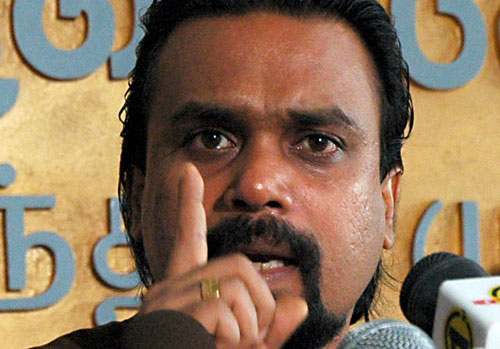
A monkey (not Comrade Wimal W who has been seen scaling the walls of many an embassy and may be easily mistaken for one on account of his on his activities if not just his appearance ) had invaded the premises.
Spot the similarities
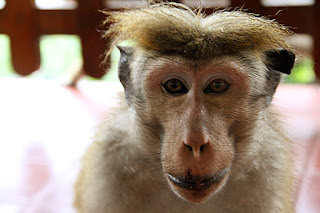
Toque macaque (Macaca sinica) is a reddish-brown-coloured Old World monkey endemic to Sri Lanka, where it is locally known as the rilewa or rilawa.

Comrade Wimal W (apparatchik extraordinaire "I will stop using my gmail account. Let us boycott Pepsi, Coca Cola, Google and McDonalds", commonly known as a buffoon).
(Images borrowed from here and here, hope nobody minds)
Sources within the embassy have also revealed that it is infested with...Rats. Gigantic rats that eat anything, from paper, to clothing, to electric wiring.
The unsolved mystery is where this wildlife is coming from, given that the the embassy lies between the sea and the main road and is surrounded on all sides by a concrete jungle that is about as hospitable to animal life as the face of Mars. There is only one patch of greenery on the entire stretch, the sprawling gardens of Temple Trees, official residence of the Prime Minister.
The prevailing theory is that the monkeys and rats have crossed over the Galle Road to take up residence at the American embassy. (Note : Crossovers, crisscrossing, double crossing and backstabbing are all part and parcel of the great parliamentary tradition of Siri Lanka so it is quite possible that the animals have learned a lesson or two).
More cynical members of the public (and assorted INGO's, and other international busybodies) may wonder if this is a case of the rats fleeing a sinking ship. True patriots however believe that these intelligent animals are in fact a fifth column, sent to sow confusion, fear and embarrassment amongst the enemy. So far, it appears, they have done a good job. New diplomats posted to Colombo are now advised to leave their families behind and bring a cat along instead......
A monkey (not Comrade Wimal W who has been seen scaling the walls of many an embassy and may be easily mistaken for one on account of his on his activities if not just his appearance ) had invaded the premises.
Spot the similarities

Toque macaque (Macaca sinica) is a reddish-brown-coloured Old World monkey endemic to Sri Lanka, where it is locally known as the rilewa or rilawa.

Comrade Wimal W (apparatchik extraordinaire "I will stop using my gmail account. Let us boycott Pepsi, Coca Cola, Google and McDonalds", commonly known as a buffoon).
(Images borrowed from here and here, hope nobody minds)

Sources within the embassy have also revealed that it is infested with...Rats. Gigantic rats that eat anything, from paper, to clothing, to electric wiring.
The unsolved mystery is where this wildlife is coming from, given that the the embassy lies between the sea and the main road and is surrounded on all sides by a concrete jungle that is about as hospitable to animal life as the face of Mars. There is only one patch of greenery on the entire stretch, the sprawling gardens of Temple Trees, official residence of the Prime Minister.
The prevailing theory is that the monkeys and rats have crossed over the Galle Road to take up residence at the American embassy. (Note : Crossovers, crisscrossing, double crossing and backstabbing are all part and parcel of the great parliamentary tradition of Siri Lanka so it is quite possible that the animals have learned a lesson or two).
More cynical members of the public (and assorted INGO's, and other international busybodies) may wonder if this is a case of the rats fleeing a sinking ship. True patriots however believe that these intelligent animals are in fact a fifth column, sent to sow confusion, fear and embarrassment amongst the enemy. So far, it appears, they have done a good job. New diplomats posted to Colombo are now advised to leave their families behind and bring a cat along instead......
Sunday, December 30, 2012
Ozymandias
The arrival of the statue of Ramesses II, in England in 1818 is believed to have inspired Shelley's poem Ozymandias, reproduced below:
I met a traveller from an antique land
Who said: "Two vast and trunkless legs of stone
Stand in the desert. Near them on the sand,
Half sunk, a shattered visage lies, whose frown
And wrinkled lip and sneer of cold command
Tell that its sculptor well those passions read
Which yet survive, stamped on these lifeless things,
The hand that mocked them and the heart that fed.
And on the pedestal these words appear:
`My name is Ozymandias, King of Kings:
Look on my works, ye mighty, and despair!'
Nothing beside remains. Round the decay
Of that colossal wreck, boundless and bare,
The lone and level sands stretch far away".
Shelley's ghost, seems to have reached across the seas, to touch the anonymous writer of the plaque below, although something seems to have been lost in translation.

Perhaps it is not just Shelley, but Macaulay as well? I am but a dilettante, the more serious students of literature may be better able to divine the sources, although the lines below seem to leave the faintest of echoes.
Post Script: The statue of Ramses II stands near the entrance to the Egyptian section of the British Museum, the link above has further details and I would urge anyone visiting London to have a look, it is indeed impressive.
Macaulay was better known as a politician who played a role in the abolishing of the slave trade and for influence on education in India.
I met a traveller from an antique land
Who said: "Two vast and trunkless legs of stone
Stand in the desert. Near them on the sand,
Half sunk, a shattered visage lies, whose frown
And wrinkled lip and sneer of cold command
Tell that its sculptor well those passions read
Which yet survive, stamped on these lifeless things,
The hand that mocked them and the heart that fed.
And on the pedestal these words appear:
`My name is Ozymandias, King of Kings:
Look on my works, ye mighty, and despair!'
Nothing beside remains. Round the decay
Of that colossal wreck, boundless and bare,
The lone and level sands stretch far away".
Shelley's ghost, seems to have reached across the seas, to touch the anonymous writer of the plaque below, although something seems to have been lost in translation.
Perhaps it is not just Shelley, but Macaulay as well? I am but a dilettante, the more serious students of literature may be better able to divine the sources, although the lines below seem to leave the faintest of echoes.
But the Consul’s brow was sad,Taken from Macaulay's Horatius.
And the Consul’s speech was low,
And darkly looked he at the wall,
And darkly at the foe.
‘Their van will be upon us
Before the bridge goes down;
And if they once may win the bridge,
What hope to save the town?’
Then out spake brave Horatius,
The Captain of the gate:
‘To every man upon this earth
Death cometh soon or late.
And how can man die better
Than facing fearful odds,
For the ashes of his fathers,
And the temples of his Gods,
Post Script: The statue of Ramses II stands near the entrance to the Egyptian section of the British Museum, the link above has further details and I would urge anyone visiting London to have a look, it is indeed impressive.
Macaulay was better known as a politician who played a role in the abolishing of the slave trade and for influence on education in India.
Friday, December 07, 2012
Diff'rent Strokes?
I picked up some weekday newspapers today. Due to pressures of work and the fact that there is only a limited number newspapers that the office subscribes to; most of which end up with the big bosses, small fry like myself rarely get hold of them.
A small box on the front page of the Daily Mirror caught my attention. On searching the web, I discovered that the Island carried much the same story.
The Colombo Telegraph, an online compilation and news site carried a story that had some similarities but entirely different connotations.
Different folk, it seems, have perceived the same thing in entirely different terms.
The BBC report is here.
Monday, November 26, 2012
The TFC deal and the Chief Justice
My post on the TFC deal seems to be picking up a lot of hits, it is now, by a large margin, my most popular post.
The impeachment of the Chief Justice, now underway is probably the cause. The connection between the TFC deal and the CJ is that the CJ's husband was the Chairman of the state-owned NSB which bought the shares at the inflated price.
That deal was undoubtedly flawed but how should that affect the impeachment? My previous post would not be helpful to anyone seeking an answer to that question, but Mr Nihal Jayawickrama, does address that here.
Mr Jayawickrama is a founder member of the Judicial Integrity Group which is devoted to the task of improving judicial integrity and accountability.
As far as the TFC deal is concerned Mr Jayawickrama is of the view that:
It is also worth remembering that this was not the only flawed deal on the CSE, the EPF has lost billions on several deals, and so has the state-owned Sri Lanka Insurance Corporation. The TFC was merely the last in a long list, which despite calls from the COPE and unions, no one seems interested in investigating. Even the investigation to the TFC deal needs to be more broad based, there were surely others, besides the chairman, who were involved?
For those interested the Chief Justice's response to the charges is here.
Updated with a few new links to relevant commentary.
The impeachment of the Chief Justice, now underway is probably the cause. The connection between the TFC deal and the CJ is that the CJ's husband was the Chairman of the state-owned NSB which bought the shares at the inflated price.
That deal was undoubtedly flawed but how should that affect the impeachment? My previous post would not be helpful to anyone seeking an answer to that question, but Mr Nihal Jayawickrama, does address that here.
Mr Jayawickrama is a founder member of the Judicial Integrity Group which is devoted to the task of improving judicial integrity and accountability.
As far as the TFC deal is concerned Mr Jayawickrama is of the view that:
"A judge’s spouse is not prevented from engaging in any activity, so long as the judge does not get involved in such activity. A lack of circumspect or good sense on the part of the spouse in choosing which activity to engage in, is not a matter for which the judge can be held responsible unless the judge was, in fact, or appeared to have been, thereby improperly influenced in his or her conduct as a judge."Mr Jayawickrama also has some interesting observations on the due process to be followed for the disciplining of judges here.
It is also worth remembering that this was not the only flawed deal on the CSE, the EPF has lost billions on several deals, and so has the state-owned Sri Lanka Insurance Corporation. The TFC was merely the last in a long list, which despite calls from the COPE and unions, no one seems interested in investigating. Even the investigation to the TFC deal needs to be more broad based, there were surely others, besides the chairman, who were involved?
For those interested the Chief Justice's response to the charges is here.
Updated with a few new links to relevant commentary.
Subscribe to:
Posts (Atom)